


Published July 17, 2024. Updated May 5, 2026. Open access. | Purchase book ❯ |
Tiger Ratsnake (Spilotes pullatus)
Reptiles of Ecuador | Serpentes | Colubridae | Spilotes pullatus
English common names: Tiger Ratsnake, Chicken Snake.
Spanish common names: Chonta tigre, serpiente tigre común (Ecuador); toche, tigra cazadora (Colombia); mica (Costa Rica).
Recognition: ♂♂ 300.2 cmMaximum distance from the snout to the tip of the tail. ♀♀ 217 cmMaximum distance from the snout to the tip of the tail..1–4 Spilotes pullatus is easily identified by its impressive size and a dorsal pattern of alternating, oblique yellow bands on a glossy black background (Fig. 1).1–5 The sides of the head are yellow with vertical black streaks, forming a characteristic tiger-striped appearance. While melanistic individuals may superficially resemble Chironius multiventris, S. pullatus is distinguished by having more than 12 rows of dorsal scales at mid-body.5,6
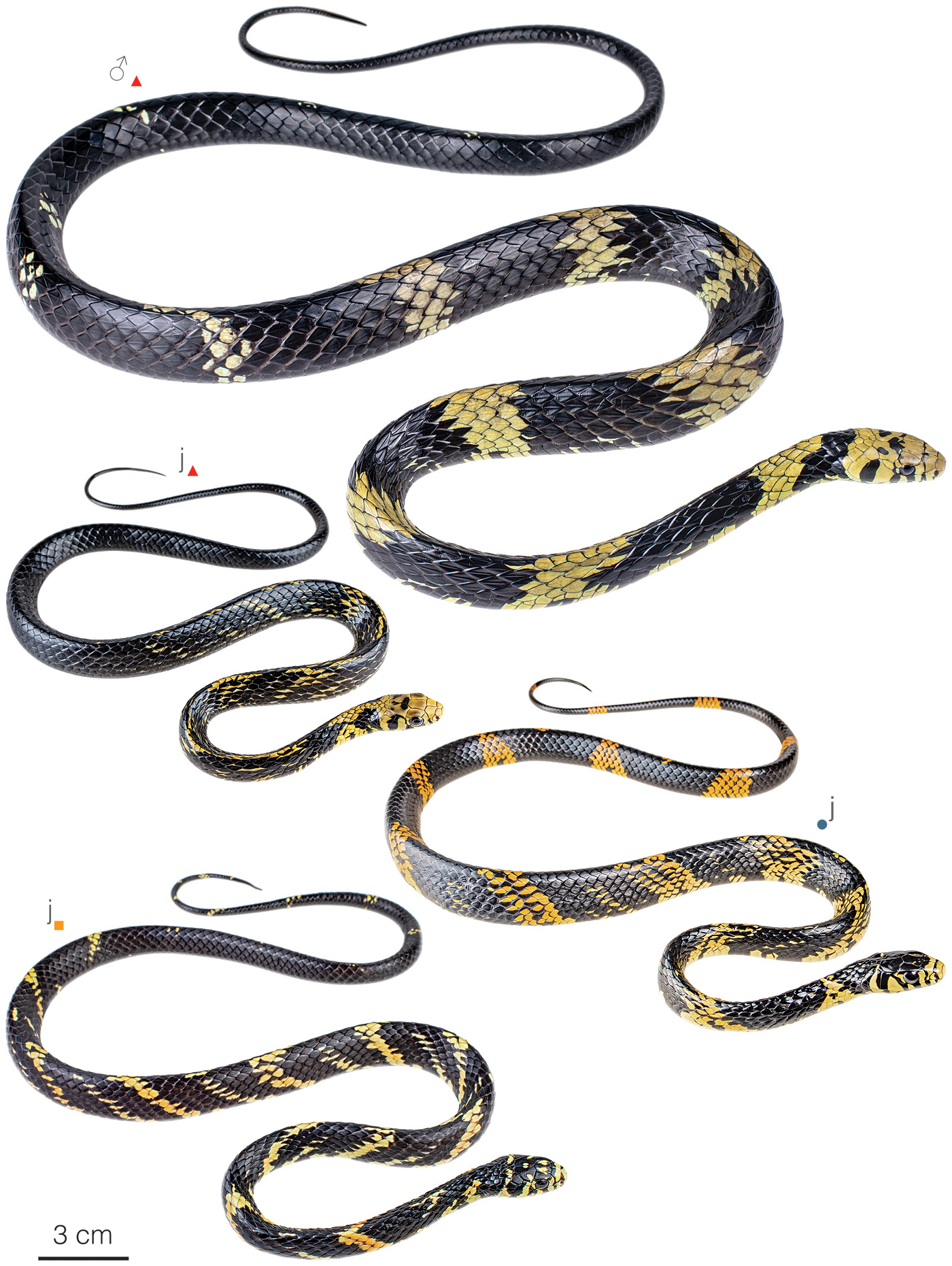
Figure 1: Individuals of Spilotes pullatus: Morromico Reserve, Chocó department, Colombia (); Caracas, Distrito Capital, Venezuela (); Palmarí, Amazonas state, Brazil (). j=juvenile.
Natural history: Spilotes pullatus is a diurnal, semi-arboreal, and terrestrial snake that occupies diverse environments, from dense rainforests to open fields.1–13 It reaches its highest abundance in semi-open habitats or forest edges along large bodies of water.1–8 Tiger Ratsnakes are typically active during sunny intervals, foraging from the forest floor to heights of 12 m in the canopy.13 Equipped with aglyphous dentition, these snakes are active foragers that hunt in both open areas and animal shelters.13 Their diet consists primarily of mammals, but also includes frogs, lizards, birds, and eggs.2,5 Small prey is consumed alive, while larger items are subdued via constriction.5,9 Like its congeners, this species is noted for raiding poultry nests. Spilotes pullatus is oviparous, with females depositing clutches of 5–25 eggs during the local dry season; the incubation period lasts between 101–117 days.2,7–10 The defensive behavior of the Tiger Ratsnake is notably aggressive: when threatened, it assumes a raised S-shaped posture, inflates its neck, and vibrates its tail.2,5 With its mouth open, it produces a hissing sound and strikes.2,5,7 Ritualized combat has been observed between males of S. pullatus.7 There are recorded instances of predation on members of this species, including by hawks,5 rodents,14 and the snake Clelia clelia.1
By purchasing the hardcover or PDF of the Reptiles of Ecuador, you help keep this website 100% free.
Conservation: Least Concern Believed to be safe from extinction given current circumstances..15 Spilotes pullatus is listed in this category on the basis of the species’ wide distribution, occurrence in numerous protected areas, and presumed large and stable populations densities.15
Distribution: Spilotes pullatus is widely distributed throughout the Neotropics, from México to Brazil. In Ecuador, the species is restricted to the Amazonian lowlands (Fig. 2).
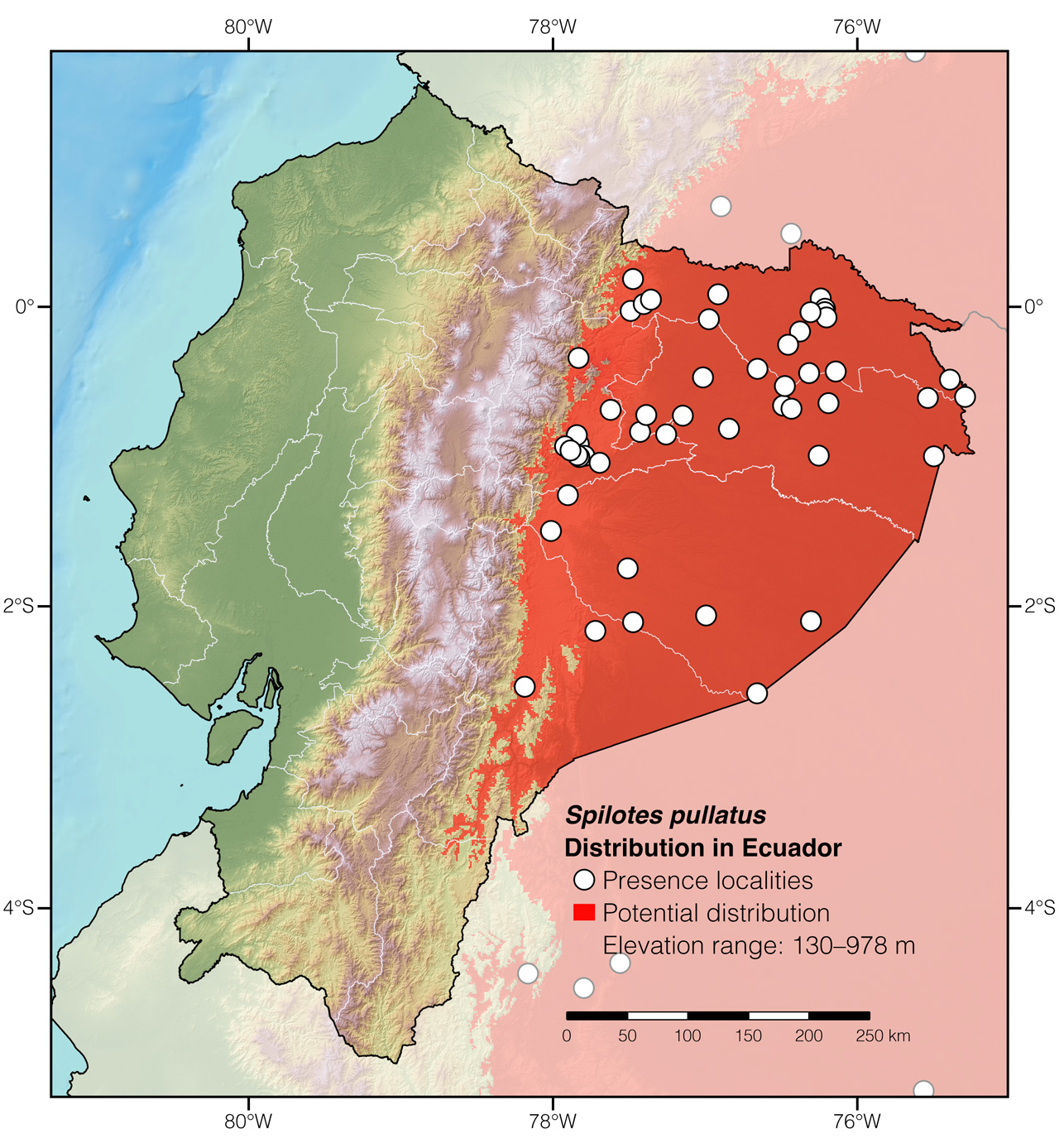
Figure 2: Distribution of Spilotes pullatus in Ecuador. See Appendix 1 for a complete list of the presence localities included in the map.
Etymology: The generic name Spilotes is a Greek word meaning “stained.”16 The specific epithet pullatus is Latin word meaning “clothed in black garments.”16 It refers to the characteristic black-and-yellow dorsal coloration of this species.
Where to observe: Individuals of Spilotes pullatus are typically seen at a rate of about once every few months throughout the Ecuadorian Amazon. A prime location for this species is Limoncocha Reserve.
Special thanks to Fausto Varela for symbolically adopting the Tiger Ratsnake and helping bring the Reptiles of Ecuador book project to life.
Authors: Alejandro ArteagaaAffiliation: Fundación Khamai, Reserva Arlequín, Ecoruta Paseo del Quinde km 56, Santa Rosa de Mindo, Pichincha 171202, Ecuador. and Gabriela AguiarbIndependent researcher, Quito, Ecuador.
Photographer: Jose VieiracAffiliation: Tropical Herping (TH), Quito, Ecuador.,dAffiliation: ExSitu, Quito, Ecuador.
How to cite? Arteaga A, Aguiar G (2026) Tiger Ratsnake (Spilotes pullatus). In: Arteaga A, Bustamante L, Vieira J (Eds) Reptiles of Ecuador: Life in the middle of the world. Available from: www.reptilesofecuador.com. https://doi.org/10.47051/YXNS3648
Literature cited:
- Campbell JA (1998) Amphibians and reptiles of northern Guatemala, the Yucatán, and Belize. University of Oklahoma Press, Norman, 380 pp.
- Martins M, Oliveira ME (1998) Natural history of snakes in forests of the Manaus region, Central Amazonia, Brazil. Herpetological Natural History 6: 78–150.
- Dixon JR, Soini P (1986) The reptiles of the upper Amazon Basin, Iquitos region, Peru. Milwaukee Public Museum, Milwaukee, 154 pp.
- Nickerson MA, Sajdak RA, Henderson RW, Ketcham S (1978) Notes on the movements of some Neotropical snakes (Reptilia, Serpentes). Journal of Herpetology 12: 419–422.
- Savage JM (2002) The amphibians and reptiles of Costa Rica, a herpetofauna between two continents, between two seas. The University of Chicago Press, Chicago, 934 pp.
- Pérez-Santos C, Moreno AG (1988) Ofidios de Colombia. Museo Regionale di Scienze Naturali, Torino, 517 pp.
- Murphy JC, Downie R, Smith JM, Livingstone S, Mohammed R, Lehtinen RM, Eyre M, Sewlal JN, Noriega N, Casper GS, Anton T, Rutherford MG, Braswell AL, Jowers MJ (2018) A field guide to the amphibians & reptiles of Trinidad and Tobago. Trinidad and Tobago Naturalist’s Club, Port of Spain, 336 pp.
- La Marca E, Soriano PJ (2004) Reptiles de los Andes de Venezuela. Fundación Polar, Mérida, 173 pp.
- Leenders T (2019) Reptiles of Costa Rica: a field guide. Cornell University Press, Ithaca, 625 pp.
- Marques OAV, Muniz-Da-Silva DF, Barbo FE, Travaglia Cardoso SR, Maia DC, Almeida-Santos SM (2014) Ecology of the Colubrid Snake Spilotes pullatus from the Atlantic Forest of Southeastern Brazil. Herpetologica 70: 407–416. https://doi.org/10.1655/HERPETOLOGICA-D-14-00012
- Natera-Mumaw M, Esqueda-González LF, Castelaín-Fernández M (2015) Atlas serpientes de Venezuela. Dimacofi Negocios Avanzados S.A., Santiago de Chile, 456 pp.
- Heimes P (2016) Snakes of Mexico. Chimaira, Frankfurt, 572 pp.
- Field notes, Reptiles of Ecuador book project.
- Pinto de Mendonça P, Cobra P, Bernardo LR, Silva-Soares T (2011) Predation of the snake Spilotes pullatus (Squamata: Serpentes) uponthe rodent Proechimys gardneri (Rodentia: Echimyidae) in the Amazonian basin, northwestern Brazil. Herpetology Notes 4: 425–427.
- Arzamendia V, Caicedo JR, Fitzgerald L, Giraudo A, Gutiérrez-Cárdenas P, Kacoliris F, Montero R, Pelegrin N, Rivas G, Scrocchi G, Williams J, Gonzales L, Nogueira CC, Gagliardi G, Cisneros-Heredia DF, Catenazzi A, Valencia J, Murphy J (2019) Spilotes sulphureus. The IUCN Red List of threatened species. Available from: www.iucnredlist.org. https://doi.org/10.2305/IUCN.UK.2019-3.RLTS.T190633A1955620.en
- Brown RW (1956) Composition of scientific words. Smithsonian Books, Washington D.C., 882 pp.
Appendix 1: Locality data used to create the distribution map of Spilotes pullatus in Ecuador (Fig. 2).
| Country | Province | Locality | Source |
| Colombia | Caquetá | Cartagena del Chairá | iNaturalist; photo examined |
| Colombia | Caquetá | Florencia | Cárdenas Hincapié & Lozano Bernal 2023 |
| Colombia | Putumayo | Nariño | Geopark Colombia 2024 |
| Colombia | Putumayo | Orito | iNaturalist; photo examined |
| Ecuador | Morona Santiago | Cunza | MZUA.RE.0001; examined |
| Ecuador | Morona Santiago | Macuma | iNaturalist; photo examined |
| Ecuador | Napo | Archidona | iNaturalist; photo examined |
| Ecuador | Napo | Coca | Nogueira et al. 2019 |
| Ecuador | Napo | Cotundo | iNaturalist; photo examined |
| Ecuador | Napo | El Chaco | iNaturalist; photo examined |
| Ecuador | Napo | Finca Fischer | TCWC 68300; VertNet |
| Ecuador | Napo | Hidroeléctrica Coca Codo Sinclair | Photo by Diego Piñán |
| Ecuador | Napo | Hostal Tena Ñaui | Online multimedia |
| Ecuador | Napo | Lago Agrio | iNaturalist; photo examined |
| Ecuador | Napo | Misahuallí | Nogueira et al. 2019 |
| Ecuador | Napo | Reserva Colonso Chalupas | iNaturalist; photo examined |
| Ecuador | Napo | Tena | MHNG 2529.011; collection database |
| Ecuador | Napo | Universidad Ikiam | Reptiles of Ecuador book database |
| Ecuador | Napo | Wild Sumaco Wildlife Sanctuary | Camper et al. 2021 |
| Ecuador | Napo | Yachana Reserve | Whitworth & Beirne 2011 |
| Ecuador | Orellana | Campo Hormiguero Sur | Nogueira et al. 2019 |
| Ecuador | Orellana | Cotapino, 5 km SE of | iNaturalist; photo examined |
| Ecuador | Orellana | Laguna Jatuncocha | USNM 204211; VertNet |
| Ecuador | Orellana | Parroquia Yurimagua | iNaturalist; photo examined |
| Ecuador | Orellana | Puerto Hermano Miguel | Torres-Carvajal et al. 2019 |
| Ecuador | Orellana | Reserva Río Bigal | Thierry García, pers. comm. |
| Ecuador | Orellana | Río Huataracu | Nogueira et al. 2019 |
| Ecuador | Orellana | SPF | iNaturalist; photo examined |
| Ecuador | Orellana | Tiputini Biodiversity Station | Cisneros-Heredia 2003 |
| Ecuador | Orellana | Vía Pompeya Sur–Iro, km 38 | Nogueira et al. 2019 |
| Ecuador | Orellana | Yasuní Scientific Station | Nogueira et al. 2019 |
| Ecuador | Pastaza | Andoas | Ortega-Andrade 2010 |
| Ecuador | Pastaza | Comunidad Puka Yaku | Nogueira et al. 2019 |
| Ecuador | Pastaza | Copataza | USNM 204213; VertNet |
| Ecuador | Pastaza | Hostal Río Anzu | Photo by Darwin Núñez |
| Ecuador | Pastaza | Puyo | MHNG 1078.039; collection database |
| Ecuador | Pastaza | Río Huiyayacu | USNM 204212; VertNet |
| Ecuador | Pastaza | Sarayacu | Nogueira et al. 2019 |
| Ecuador | Sucumbíos | Bloque 15 | Izquierdo et al. 2000 |
| Ecuador | Sucumbíos | Campo Unita | iNaturalist; photo examined |
| Ecuador | Sucumbíos | Estación PUCE en Cuyabeno | Nogueira et al. 2019 |
| Ecuador | Sucumbíos | Garzacocha | iNaturalist; photo examined |
| Ecuador | Sucumbíos | Gonzalo Pizarro | iNaturalist; photo examined |
| Ecuador | Sucumbíos | Guacamayo Lodge | Online multimedia |
| Ecuador | Sucumbíos | La Charata | iNaturalist; photo examined |
| Ecuador | Sucumbíos | La Selva Lodge | Photo by Ana Santacruz |
| Ecuador | Sucumbíos | Lagartococha | iNaturalist; photo examined |
| Ecuador | Sucumbíos | Limoncocha | Photo by Eric Osterman |
| Ecuador | Sucumbíos | Lumbaqui | iNaturalist; photo examined |
| Ecuador | Sucumbíos | Napo Wildlife Center | Reptiles of Ecuador book database |
| Ecuador | Sucumbíos | Nicky Amazon Lodge | iNaturalist; photo examined |
| Ecuador | Sucumbíos | Pañacocha | iNaturalist; photo examined |
| Ecuador | Sucumbíos | Río Cuyabeno | Uetz et al. 2024 |
| Ecuador | Sucumbíos | San Pablo de Kantesiya | Nogueira et al. 2019 |
| Ecuador | Sucumbíos | Sani Lodge | Reptiles of Ecuador book database |
| Ecuador | Sucumbíos | Santa Cecilia | Nogueira et al. 2019 |
| Ecuador | Sucumbíos | Zancudococha | Reptiles of Ecuador book database |
| Perú | Amazonas | Mouth of Río Najem | MVZ 163313; VertNet |
| Perú | Amazonas | Puerto Galilea | USNM 566609; VertNet |
| Perú | Amazonas | Santa Rosa, 1 km E of | MVZ 175337; VertNet |
| Perú | Loreto | Centro Unión | Dixon & Soni 1986 |
| Perú | Loreto | Cerro de Kampankis | Catenazzi & Venegas 2016 |
| Perú | Loreto | Iquitos | Dixon & Soni 1986 |
| Perú | Loreto | Moropon | Dixon & Soni 1986 |
| Perú | Loreto | Poza Gloria | iNaturalist; photo examined |
| Perú | Loreto | Santa María | TCWC 44713; VertNet |
| Perú | Loreto | Yanamono | TCWC 38205; VertNet |