


Published July 17, 2024. Updated May 16, 2026. Open access. | Purchase book ❯ |
Red Leaf-Litter Snake (Xenopholis scalaris)
Reptiles of Ecuador | Serpentes | Colubridae | Xenopholis scalaris
English common names: Red Leaf-Litter Snake, Wucherer’s Ground Snake, Flat-headed Snake, Red Terrier-Snake.
Spanish common names: Culebra roja de hojarasca, serpiente de cabeza plana.
Recognition: ♂♂ 41.5 cmMaximum distance from the snout to the tip of the tail. Snout–vent length=34.0 cm. ♀♀ 35.4 cmMaximum distance from the snout to the tip of the tail. Snout–vent length=29.5 cm..1–3 Xenopholis scalaris can be readily distinguished from other small, terrestrial Amazonian snakes by its highly unique cephalic lepidosis: it possesses fused prefrontal scales that form a single, distinct plate or shield across the snout.1–5 Additional diagnostic features include round pupils, smooth dorsal scales, and a characteristic color pattern. The dorsal ground color ranges from reddish-brown to a vibrant brick-red, shifting to bright orange along the lower flanks (Fig. 1). This background is overlaid by a series of prominent, dark brown crossbars that frequently coalesce along the vertebral line.1–5 While superficially similar to certain ground snakes of the genus Atractus or cat-eyed snakes of the genus Leptodeira, X. scalaris is immediately differentiated from both genera by the presence of its fused prefrontal shield (paired in Atractus and Leptodeira).
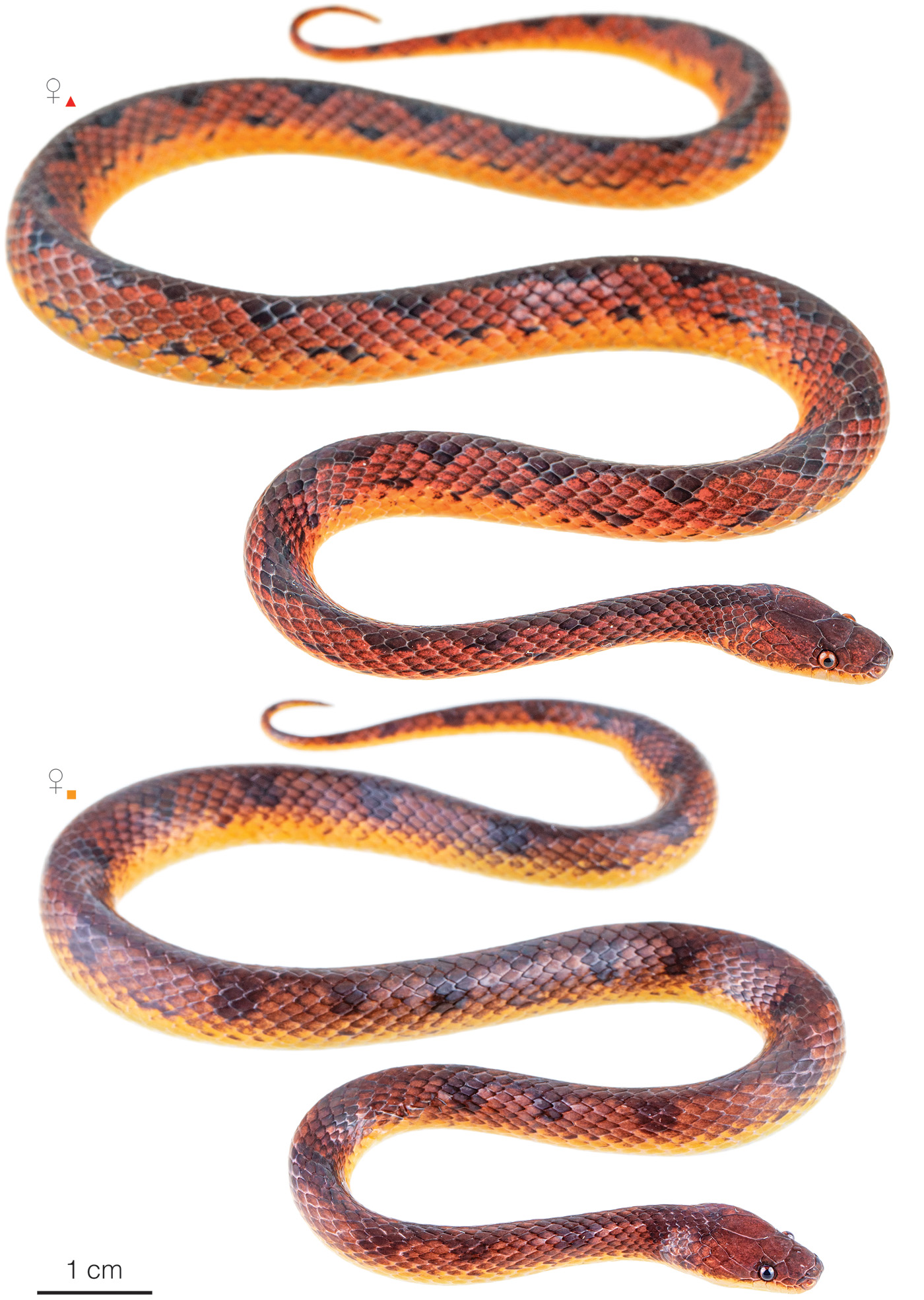
Figure 1: Individuals of Xenopholis scalaris from Cuyabeno Reserve, Sucumbíos province, Ecuador: Tucán Lodge (); Aguas Negras Lodge ().
Natural history: Xenopholis scalaris is a terrestrial and cryptozoic (secretive/litter-dwelling) snake primarily restricted to pristine lowland rainforests, including both terra-firme (unflooded) and seasonally inundated ecosystems.1–7 While it occasionally persists in human-modified landscapes, its population densities there are lower. These snakes are predominantly nocturnal, with peak foraging activity occurring within the leaf-litter during high-humidity events or along the margins of streams and swamps.1–6 On occasion, individuals will ascend into the low understory vegetation up to 0.5 m above the forest floor.3 During the day, they remain hidden beneath fallen palm fronds or deep within the leaf-litter, though diurnal surface movement is occasionally observed.1–6 Xenopholis scalaris is a highly specialized anurophage (frog specialist).7 Its documented prey includes microhylid frogs (Hamptophryne),1,3 jungle frogs (Adenomera),1,6 ground frogs (Oreobates and Pristimantis),3,6 and rocket frogs (Allobates).8 When threatened, this species exhibits a stereotyped defensive display: it stiffens its spine while flattening its body dorsoventrally, conceals its head beneath its body coils, and frequently exhibits thanatosis (feigning death).1,6,9 Reproduction is oviparous, with females producing small clutches of 2–3 eggs.1,3,6
By purchasing the hardcover or PDF of the Reptiles of Ecuador, you help keep this website 100% free.
Conservation: Least Concern Believed to be safe from extinction given current circumstances..10 Xenopholis scalaris is included in this category because the species is widely distributed, occurs in major protected areas, and is believed to be facing no major immediate threats of extinction.
Distribution: Xenopholis scalaris is widespread throughout Amazonia in Bolivia, Brazil, Colombia, Ecuador (Fig. 2), French Guiana, Perú, and Venezuela, with an isolated population in the Atlantic Forest of Brazil.11
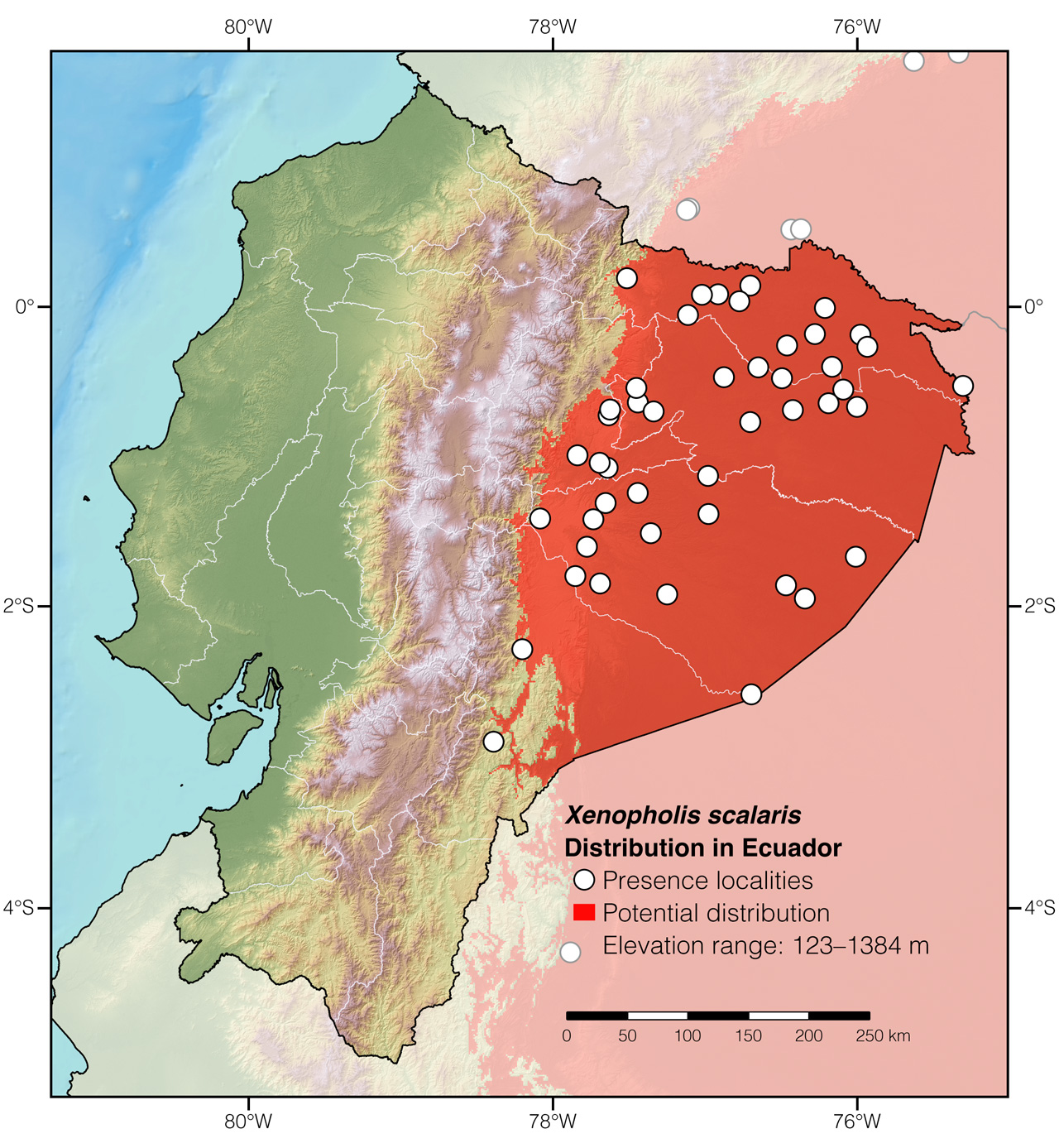
Figure 2: Distribution of Xenopholis scalaris in Ecuador. See Appendix 1 for a complete list of the presence localities included in the map.
Etymology: The name Xenopholis comes from the Greek words xeno (=different) and pholis (=scale), referring to a specimen in which the prefrontal scale was divided into a medial and two lateral scales.5 This character is thought12 to be an anomaly present only in the type specimen.5,13 The specific epithet scalaris is a Latin word meaning “ladder,”14 probably referring to the dorsal pattern.
Where to observe: While Xenopholis scalaris is widely distributed across the Ecuadorian Amazon, it is most frequently encountered within the Cuyabeno Reserve. In this locality, the species is relatively common and can be observed at a rate of once every few nights during targeted nocturnal foot surveys along forest trails.
Special thanks to Kathleen Woodley for symbolically adopting the Red Leaf-Litter Snake and helping bring the Reptiles of Ecuador book project to life.
Authors: Danna Duque-Torres,aAffiliation: Grupo de Ornitología, Universidad Nacional de Colombia, Bogotá, Colombia. Andrés F. Aponte-Gutiérrez,bAffiliation: Grupo de Investigación en Ciencias de la Orinoquía, Universidad Nacional de Colombia sede Orinoquía, Arauca, Colombia.,cAffiliation: Fundación Biodiversa Colombia, Bogotá, Colombia. and Tatiana Molina-MorenodAffiliation: Departamento de Biología, Universidad de los Llanos, Villavicencio, Colombia.
Editor: Alejandro ArteagaeAffiliation: Fundación Khamai, Reserva Arlequín, Ecoruta Paseo del Quinde km 56, Santa Rosa de Mindo, Pichincha 171202, Ecuador.
Photographer: Jose VieirafAffiliation: Tropical Herping (TH), Quito, Ecuador.,gAffiliation: ExSitu, Quito, Ecuador.
How to cite? Duque-Torres D, Aponte-Gutiérrez A, Molina-Moreno T (2026) Red Leaf-Litter Snake (Xenopholis scalaris). In: Arteaga A, Bustamante L, Vieira J (Eds) Reptiles of Ecuador: Life in the middle of the world. Available from: www.reptilesofecuador.com. DOI: 10.47051/GDHF5651
Literature cited:
- Martins M, Oliveira ME (1998) Natural history of snakes in forests of the Manaus region, Central Amazonia, Brazil. Herpetological Natural History 6: 78–150.
- Dixon JR, Soini P (1986) The reptiles of the upper Amazon Basin, Iquitos region, Peru. Milwaukee Public Museum, Milwaukee, 154 pp.
- Duellman WE (2005) Cusco amazónico: the lives of amphibians and reptiles in an Amazonian rainforest. Cornell University Press, Ithaca, 433 pp.
- de Fraga R, Lima AP, da Costa Prudente AL, Magnusson WE (2013) Guia de cobras da região de Manaus - Amazônia Central. Editopa Inpa, Manaus, 303 pp.
- Jansen M, Gonzalez Álvarez L, Köhler G (2009) Description of a new species of Xenopholis (Serpentes: Colubridae) from the Cerrado of Bolivia, with comments on Xenopholis scalaris in Bolivia. Zootaxa 2222: 31–45. DOI: 10.5281/zenodo.190108
- dos Santos-Costa MC, Maschio GF, da Costa Prudente AL (2015) Natural history of snakes from Floresta Nacional de Caxiuanã, eastern Amazonia, Brazil. Herpetology Notes 8: 69–98.
- Cunha OR, Nascimento FP (1978) Ofídios da Amazônia. X. As cobras da região leste do Pará. Papéis Avulsos Museu Paraense Emílio Goeldi 31: 1–218.
- Ringler M, Ursprung E, Hödl W (2010) Predation on Allobates femoralis (Boulenger 1884; Anura: Aromobatidae) by the colubrid snake Xenopholis scalaris (Wucherer 1861). Herpetology Notes 3: 301–304.
- De Mira Mendes CV, De Oliveira RM, Silva Ruas D, Ribeiro Dias I, Suzart Argôlo AJ (2010) Xenopholis scalaris (Wucherer’s Ground Snake): defensive behavior. Herpetological Review 44: 699.
- Doan TM, Ines Hladki A, Lehr E, Ramírez Pinilla M, Renjifo J, Urbina N, Valencia J, Gonzales L, Catenazzi A, Nogueira CC (2019) Xenopholis scalaris. The IUCN Red List of threatened species. Available from: www.iucnredlist.org. DOI: 10.2305/IUCN.UK.2019-3.RLTS.T177550A44952190.en
- Nogueira CC, Argôlo AJS, Arzamendia V, Azevedo JA, Barbo FE, Bérnils RS, Bolochio BE, Borges-Martins M, Brasil-Godinho M, Braz H, Buononato MA, Cisneros-Heredia DF, Colli GR, Costa HC, Franco FL, Giraudo A, Gonzalez RC, Guedes T, Hoogmoed MS, Marques OAV, Montingelli GG, Passos P, Prudente ALC, Rivas GA, Sanchez PM, Serrano FC, Silva NJ, Strüssmann C, Vieira-Alencar JPS, Zaher H, Sawaya RJ, Martins M (2019) Atlas of Brazilian snakes: verified point-locality maps to mitigate the Wallacean shortfall in a megadiverse snake fauna. South American Journal of Herpetology 14: 1–274. DOI: 10.2994/SAJH-D-19-00120.1
- Boulenger GA (1896) Catalogue of the snakes in the British Museum. Taylor & Francis, London, 727 pp.
- Peters WCH (1869) Über neue Gattungen und neue oder weniger bekannte Arten von Amphibien (Eremias, Dicrodon, Euprepes, Lygosoma, Typhlops, Eryx, Rhynchonyx, Elapomorphus, Achalinus, Coronella, Dromicus, Xenopholis, Anoplodipsas, Spilotes, Tropidonotus). Monatsberichte der Königlichen Preussische Akademie des Wissenschaften zu Berlin 1869: 432–447.
- Brown RW (1956) Composition of scientific words. Smithsonian Books, Washington D.C., 882 pp.
Appendix 1: Locality data used to create the distribution map of Xenopholis scalaris in Ecuador (Fig. 2).
| Country | Province | Locality | Source |
| Colombia | Amazonas | Cantadero | Calderón et al. 2023 |
| Colombia | Amazonas | Comunidad de San Antonio | Caicedo Portilla et al. 2023 |
| Colombia | Amazonas | El Encanto | Caicedo Portilla et al. 2023 |
| Colombia | Amazonas | Finca Aguas Claras | Calderón et al. 2023 |
| Colombia | Amazonas | Jitoma | Calderón et al. 2023 |
| Colombia | Amazonas | Puerto Nariño | iNaturalist; photo examined |
| Colombia | Amazonas | Yoi Ecolodge | iNaturalist; photo examined |
| Colombia | Caquetá | El Doncello | iNaturalist; photo examined |
| Colombia | Caquetá | Florencia | iNaturalist; photo examined |
| Colombia | Putumayo | Mansoyá | Geopark Colombia 2022 |
| Colombia | Putumayo | Pozo Platanillo | Geopark Colombia 2022 |
| Colombia | Putumayo | RN La Isla Escondida | iNaturalist; photo examined |
| Colombia | Putumayo | Vereda Valle de las Palmeras | Borja-Acosta & Galeano Muñoz 2023 |
| Ecuador | Canelos | Canelos | Nogueira et al. 2019 |
| Ecuador | Morona Santiago | Limón | UTA 37980; GBIF |
| Ecuador | Morona Santiago | Normandía | AMNH 35920; examined |
| Ecuador | Napo | Guamaní | Nogueira et al. 2019 |
| Ecuador | Napo | Jatun Sacha Biological Reserve | Reptiles of Ecuador book database |
| Ecuador | Napo | Misahuallí | Photo by Diego Piñán |
| Ecuador | Napo | San Pablo de Kantesiya | MHNG 2397.064; collection database |
| Ecuador | Napo | Tena | USNM 233072; VertNet |
| Ecuador | Napo | Wildsumaco Wildlife Sanctuary | Camper et al. 2021 |
| Ecuador | Orellana | Ávila | Nogueira et al. 2019 |
| Ecuador | Orellana | Chiru Isla, 11 km SW of | Nogueira et al. 2019 |
| Ecuador | Orellana | Edén Amazon Lodge | Photo by Ryan Lynch |
| Ecuador | Orellana | Loreto | USNM 233070; VertNet |
| Ecuador | Orellana | Reserva Río Bigal | García et al. 2021 |
| Ecuador | Orellana | Tiputini Biodiversity Station | Cisneros-Heredia 2003 |
| Ecuador | Orellana | Yarina Lodge | Bringsøe 2024 |
| Ecuador | Orellana | Yasuní Scientific Station, environs of | iNaturalist; photo examined |
| Ecuador | Pastaza | Alto Curaray | USNM 233079; VertNet |
| Ecuador | Pastaza | Andoas | Nogueira et al. 2019 |
| Ecuador | Pastaza | Arutam | Nogueira et al. 2019 |
| Ecuador | Pastaza | Balsaura | Ortega-Andrade 2010 |
| Ecuador | Pastaza | Pucayacu (Río Pucayacu) | USNM 233085; VertNet |
| Ecuador | Pastaza | Río Copataza | USNM 233091; VertNet |
| Ecuador | Pastaza | Río Oglán | USNM 233087; VertNet |
| Ecuador | Pastaza | Río Pintoyacu | Nogueira et al. 2019 |
| Ecuador | Pastaza | Río Villano | USNM 233084; VertNet |
| Ecuador | Pastaza | Sacha Yaku | Reptiles of Ecuador book database |
| Ecuador | Pastaza | Saladero Lorocachi | Carvajal-Campos 2020 |
| Ecuador | Pastaza | San Jose de Curaray | Nogueira et al. 2019 |
| Ecuador | Pastaza | Sumak Kawsay In Situ | Bentley et al. 2021 |
| Ecuador | Pastaza | Tigüino | USNM 321135; VertNet |
| Ecuador | Sucumbíos | Aguas Negras Lodge | Reptiles of Ecuador book database |
| Ecuador | Sucumbíos | Amazon Dolphin Lodge | Reptiles of Ecuador book database |
| Ecuador | Sucumbíos | Comunidad 26 de Junio | Nogueira et al. 2019 |
| Ecuador | Sucumbíos | Lago Agrio | Duelman 1978 |
| Ecuador | Sucumbíos | Laguna Grande | Reptiles of Ecuador book database |
| Ecuador | Sucumbíos | Limoncocha | UIMNH 61218; VertNet |
| Ecuador | Sucumbíos | Pindo, 8 km SE of | Nogueira et al. 2019 |
| Ecuador | Sucumbíos | Playas del Cuyabeno | iNaturalist; photo examined |
| Ecuador | Sucumbíos | Pozo Zafiro | Nogueira et al. 2019 |
| Ecuador | Sucumbíos | Puerto Libre | KU 121929; VertNet |
| Ecuador | Sucumbíos | Santa Cecilia | Duellman 1978 |
| Ecuador | Sucumbíos | Santa Elena | iNaturalist; photo examined |
| Ecuador | Sucumbíos | Shushufindi | iNaturalist; photo examined |
| Ecuador | Sucumbíos | Territorio Cofán Dureno | Yánez-Muñoz & Chimbo 2007 |
| Ecuador | Sucumbíos | Tucán Lodge | This work; Fig. 1 |
| Perú | Amazonas | Kagka | MVZ 163426; VertNet |
| Perú | Amazonas | La Poza | USNM 566625; VertNet |
| Perú | Loreto | Aguas Negras | USNM 521059; VertNet |
| Perú | Loreto | El Recreo | iNaturalist; photo examined |
| Perú | Loreto | Maynas | iNaturalist; photo examined |
| Perú | Loreto | Mazán, 3 km NE of | iNaturalist; photo examined |
| Perú | Loreto | Pebas, 50 km W of | iNaturalist; photo examined |
| Perú | Loreto | San Rafael | iNaturalist; photo examined |
| Perú | Loreto | Santa Teresa | iNaturalist; photo examined |