


Published May 30, 2024. Updated May 19, 2026. Open access.
South American Pond Snake (Pseudoeryx plicatilis)
Reptiles of Ecuador | Serpentes | Colubridae | Pseudoeryx plicatilis
English common name: South American Pond Snake.
Spanish common names: Culebra acuática arrugada, culebra anguila.
Recognition: ♂♂ 87.6 cmMaximum distance from the snout to the tip of the tail. Snout–vent length=76.2 cm. ♀♀ 144.1 cmMaximum distance from the snout to the tip of the tail. Snout–vent length=127.7 cm..1,2 Pseudoeryx plicatilis is among the most unmistakable serpents inhabiting the Amazon basin. It features a robust body that is distinctly flattened dorsoventrally, covered in smooth, glossy dorsal scales, and terminates in a compact, wedge-shaped head equipped with small, dorsally-oriented red eyes.1,3 The adult dorsal ground color is typically a deep olive-brown partitioned by faint, light yellowish-brown dorsolateral stripes, which are bordered inferiorly by bold, thick black lateral bands (Fig. 1).1,3–5 The gular region and ventral scales are pale yellow, punctuated by longitudinal rows of distinct black spots.1,3 Ontogenetic color change is pronounced; juveniles display a more contrasting and vibrant color pattern, featuring sharp cream-yellow dorsolateral stripes and a vivid orange-red ventral surface. No other aquatic or semi-aquatic snake species within the Ecuadorian Amazon shares this diagnostic combination of characters.
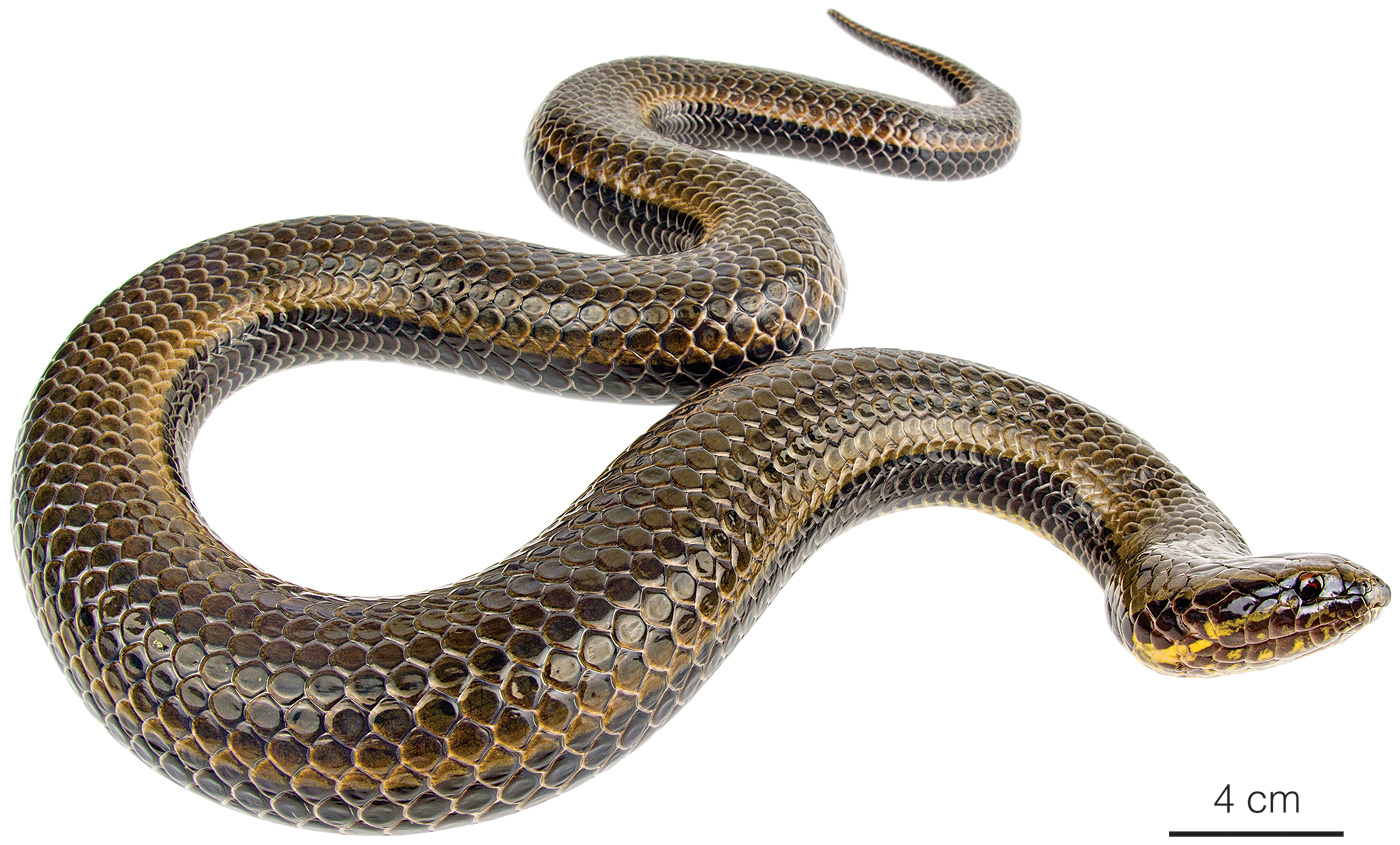
Figure 1: Adult female of Pseudoeryx plicatilis from Emerald Arch’s Reserve near the Cuyabeno Reserve, Sucumbíos province, Ecuador.
Natural history: Pseudoeryx plicatilis is an aquatic snake that primarily occupies slow-moving blackwater rivers, lagoons, marshes, swamps, and oxbow lakes in seasonally inundated lowland rainforests.1–7 South American Pond Snakes are predominantly nocturnal, dividing their time across varying aquatic depths where they alternate between active foraging and sit-and-wait ambush hunting.1,3,8 On occasion, individuals are encountered crawling over the forest floor or crossing roads, movements presumably associated with overland migration between unconnected water bodies.1,8 The diet of P. plicatilis is highly piscivorous, consisting predominantly of fish—including specialized prey like swamp eels (Synbranchus)—while occasionally supplementing with amphibians.1,2,5,8 This species employs a diverse repertoire of anti-predator mechanisms.9 When handled, it typically refrains from biting, relying instead on concealment strategies: it hides its head beneath tight body coils, produces foul cloacal discharges, flattens its body dorsoventrally, and rolls over to expose its brightly colored, warningly colored ventral surface. Reproduction is oviparous with high fecundity, producing large clutches of 22–49 eggs.8,10,11 Notably, females exhibit maternal care, remaining coiled around the eggs throughout the incubation period to provide protection.10,11
By purchasing the hardcover or PDF of the Reptiles of Ecuador, you help keep this website 100% free.
Conservation: Least Concern Believed to be safe from extinction given current circumstances..12 Pseudoeryx plicatilis is maintained in this category due to its vast Neotropical distribution, documented presence across a diverse network of continuous protected areas, and a lack of evidence suggesting significant, range-wide population declines.12 While there is no information on the population trend of the South American Pond Snake at the national level, its numbers are expected to be declining alongside the decrease in water quality experienced by Amazonian rivers in northern Ecuador.
Distribution: Pseudoeryx plicatilis is widespread throughout Amazonia and peripheral areas in Bolivia, Brazil, Colombia, Ecuador (Fig. 2), French Guiana, Guyana, Paraguay, Perú, Suriname, and Venezuela, with a global range of ~1,088,089 km2.
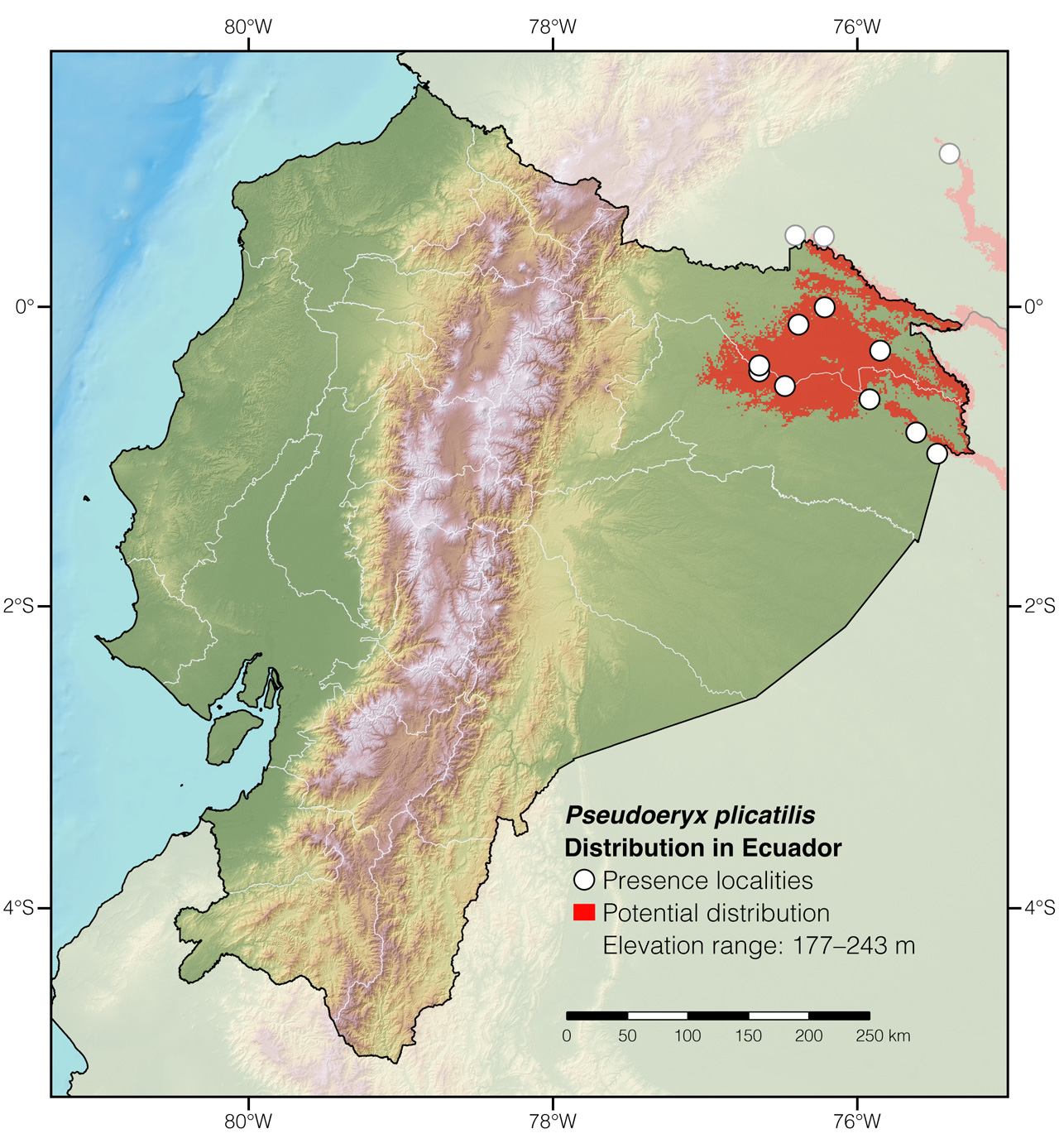
Figure 2: Distribution of Pseudoeryx plicatilis in Ecuador. See Appendix 1 for a complete list of the presence localities included in the map.
Etymology: The generic name Pseudoeryx comes from the Greek words pseudo (=false)13 and Eryx (a genus of Old World sand boas), referring to the similarity between snakes of the two genera. The specific epithet plicatilis is a Latin word meaning “foldable,” probably referring to the ventro-lateral skin fold of the alcohol-preserved holotype.
Where to observe: In Ecuador, Pseudoeryx plicatilis is an exceptionally elusive species, typically recorded no more than once every few years at any given locality. Recently, individuals have been encountered within the Reserva Biológica Limoncocha and along the margins of Añangu Lake. These highly specialized aquatic snakes are most effectively detected by meticulously scanning the shallow margins of Amazonian lagoons during the first few hours after dusk, when they rise toward the surface to forage.
Acknowledgments: Special thanks to Harry Turner of Emerald Arch for finding the individual of Pseudoeryx plicatilis photographed in this account.
Authors: Tatiana Molina-Moreno,aAffiliation: Departamento de Biología, Universidad de los Llanos, Villavicencio, Colombia. Sophia Hurtado,bAffiliation: Universidad ICESI, Cali, Colombia. Andrés F. Aponte-Gutiérrez,cAffiliation: Grupo de Investigación en Ciencias de la Orinoquía, Universidad Nacional de Colombia sede Orinoquía, Arauca, Colombia.,dAffiliation: Fundación Biodiversa Colombia, Bogotá, Colombia. and Alejandro ArteagaeAffiliation: Fundación Khamai, Reserva Arlequín, Ecoruta Paseo del Quinde km 56, Santa Rosa de Mindo, Pichincha 171202, Ecuador.
Photographer: Jose VieirafAffiliation: Tropical Herping (TH), Quito, Ecuador.,gAffiliation: ExSitu, Quito, Ecuador.
How to cite? Molina-Moreno T, Hurtado S, Aponte-Gutiérrez AF, Arteaga A (2026) South American Pond Snake (Pseudoeryx plicatilis). In: Arteaga A, Bustamante L, Vieira J (Eds) Reptiles of Ecuador: Life in the middle of the world. Available from: www.reptilesofecuador.com. DOI: 10.47051/IGOK8377
Literature cited:
- Dixon JR, Soini P (1986) The reptiles of the upper Amazon Basin, Iquitos region, Peru. Milwaukee Public Museum, Milwaukee, 154 pp.
- Kaefer IL, Montanarin A (2010) Pseudoeryx plicatilis (South American Pond Snake): diet. Herpetological Review 41: 372.
- Duellman WE (2005) Cusco amazónico: the lives of amphibians and reptiles in an Amazonian rainforest. Cornell University Press, Ithaca, 433 pp.
- Pérez-Santos C, Moreno AG (1988) Ofidios de Colombia. Museo Regionale di Scienze Naturali, Torino, 517 pp.
- Starace F (1998) Serpents et amphisbènes de Guyane Française. Ibis Rouge Editions, Guadeloupe, 450 pp.
- Strüssmann C, Sazima I (1993) The snake assemblage of the Pantanal at Poconé, Western Brazil: faunal composition and ecological summary. Studies on Neotropical Fauna and Environment 28: 157–168.
- Scartozzoni RR, Trevine VC, Germano VJ (2010) Reptilia, Squamata, Serpentes, Dipsadidae, Pseudoeryx plicatilis (Linnaeus, 1758): new records and geographic distribution map. Check List 6: 534–537.
- Field notes, Reptiles of Ecuador book project.
- Cavalheri DG, Santos Carvalho P, Santana DJ (2021) Defensive repertory of Pseudoeryx plicatilis (Linnaeus, 1758) in the Pantanal, Mato Grosso do Sul, Brazil. Cuadernos de Herpetología 35: 161–164.
- Frota JG, Yuki RN (2005) Pseudoeryx plicatilis plicatilis (Eel snake): reproduction. Herpetological Review 36: 326.
- Braz H, Scartozzoni R, Almeida-Santos SM (2016) Reproductive modes of the South American water snakes : a study system for the evolution of viviparity in squamate reptiles. Zoologischer Anzeiger 263: 33–44. DOI: 10.1016/j.jcz.2016.04.003
- Gagliardi G, Nogueira CC, Embert D, Cisneros-Heredia DF, Gonzales L, Catenazzi A, Schargel W, Rivas G, Silveira AL, Argôlo AJS, Abrahão CR, Strüssmann C, Loebmann D, Barbo FE, Franco FL, Costa GC, de Moura GJB, Zaher HD, Borges-Martins M, Martins MRC, Oliveira ME, Hoogmoed MS, Marques OAV, Passos PGH, Bérnils RS, Kawashita-Ribeiro RA, Sawaya RJ, da Costa TBG (2019) Pseudoeryx plicatilis. The IUCN Red List of threatened species. Available from: www.iucnredlist.org. DOI: 10.2305/IUCN.UK.2019-2.RLTS.T177528A44951789.en
- Brown RW (1956) Composition of scientific words. Smithsonian Books, Washington D.C., 882 pp.
Appendix 1: Locality data used to create the distribution map of Pseudoeryx plicatilis in Ecuador (Fig. 2).
| Country | Province | Locality | Source |
| Colombia | Caquetá | Milán | iNaturalist; photo examined |
| Colombia | Putumayo | Río Cocaya | iNaturalist; photo examined |
| Ecuador | Orellana | Comunidad Chiru Isla | Nogueira et al. 2019 |
| Ecuador | Orellana | Río Tambococha | Nogueira et al. 2019 |
| Ecuador | Orellana | Río Tiputini | Pazmiño-Otamendi 2021 |
| Ecuador | Putumayo | Río Putumayo | Geopark Colombia S.A.S. |
| Ecuador | Sucumbíos | Confluencia del Río Jivino y Río Napo | Nogueira et al. 2019 |
| Ecuador | Sucumbíos | Entre bocana Cuyabeno y Zábalo | Nogueira et al. 2019 |
| Ecuador | Sucumbíos | Estación PUCE en Cuyabeno | Nogueira et al. 2019 |
| Ecuador | Sucumbíos | Limococha Biological Reserve | Reptiles of Ecuador book database |
| Ecuador | Sucumbíos | Napo Wildlife Center | Scartozzoni et al. 2010 |
| Ecuador | Sucumbíos | Tarapoa | Scartozzoni et al. 2010 |
| Perú | Loreto | Centro Unión | Dixon & Soini 1986 |
| Perú | Loreto | Iquitos | Dixon & Soini 1986 |
| Perú | Loreto | Mishana | Dixon & Soini 1986 |
| Perú | Loreto | Moropon | Dixon & Soini 1986 |