


Published December 17, 2020. Updated April 4, 2026 Open access. Peer-reviewed. | Purchase book ❯ |
Günther’s Sun Tegu (Euspondylus guentheri)
Reptiles of Ecuador | Sauria | Gymnophthalmidae | Euspondylus guentheri
English common name: Günther’s Sun Tegu.
Spanish common name: Lagartija tegú de Günther.
Recognition: ♂♂ 24.9 cmMaximum distance from the snout to the tip of the tail. Snout–vent length=9.4 cm. ♀♀ 22.8 cmMaximum distance from the snout to the tip of the tail. Snout–vent length=8.4 cm..1–3 Species of the genus Euspondylus are distinguished from similar arboreal microteiids (such as Anadia, Cercosaura, and Selvasaura) by their smooth or striated rectangular dorsal scales, flank scales smaller than the dorsals, and the absence of a pale vertebral stripe.1,4 The Günther’s Sun Tegu (E. guentheri) differs from its only Ecuadorian congener, E. maculatus, primarily in coloration. Adults feature a dorsal pattern of irregular black crossbars or blotches on a lighter background, while juveniles exhibit a striking pattern of black crossbars on a bright yellowish ground color.1–3 While some Anadia petersi possess similar black dorsal blotches, they can be distinguished by a dark brown lateral stripe, which is absent in E. guentheri. Additionally, Cercosaura species have granular scales on the side of the neck, whereas these scales are large and plate-like in Euspondylus.4
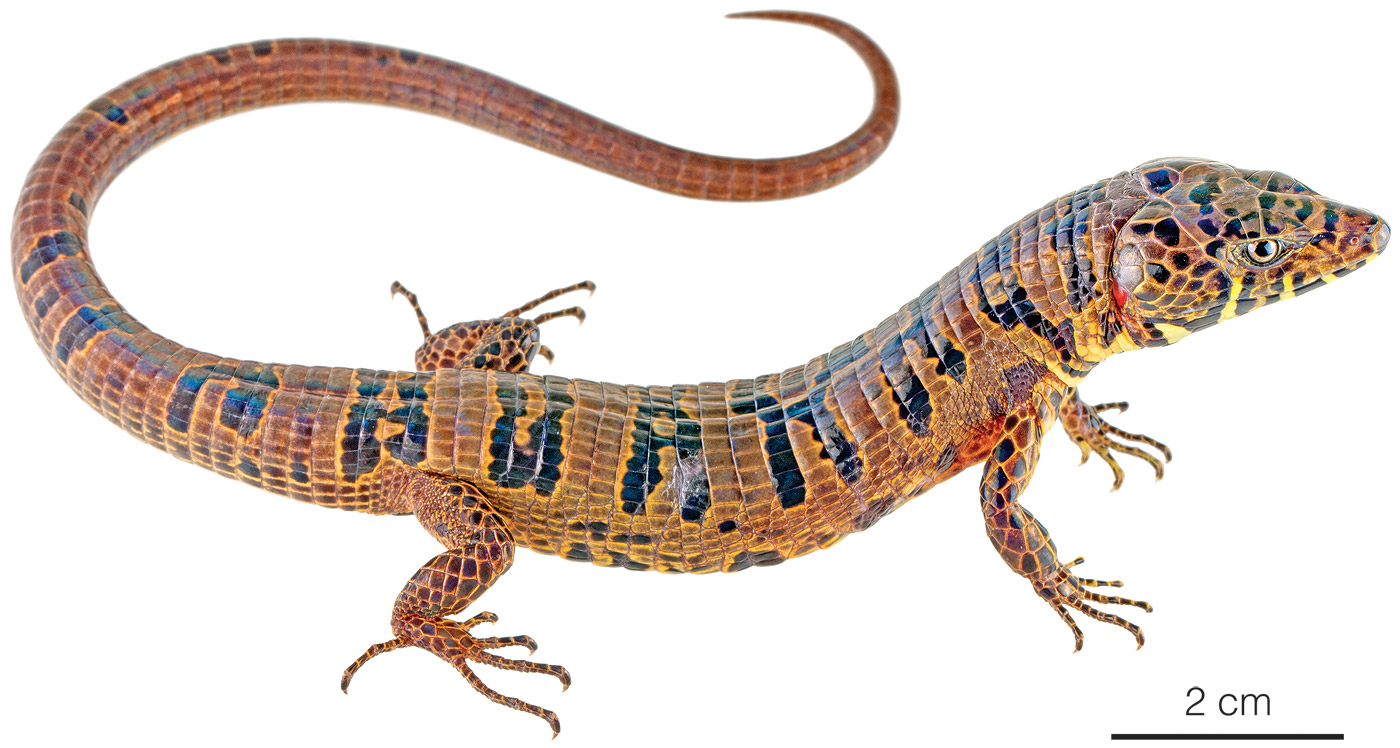
Figure 1: Individuals of Euspondylus guentheri from Ecuador: Cabeceras del Bobonaza, Pastaza province, (); unknown locality ().
Natural history: Euspondylus guentheri is an extremely rare, primarily diurnal, and arboreal lizard. It inhabits old-growth and moderately disturbed evergreen lowland and foothill forests, though it occasionally ventures near human settlements.5 Individuals have been observed basking at ground level among roots and leaf-litter, or moving on branches approximately 1 m above the forest floor.5,6 One nocturnal observation involved an individual active on a muddy wall inside the forest.3 When inactive, they hide under fallen branches, beneath thick leaf-litter, or among woody fungi on tree bark up to 2 m high.3,7,8 When threatened, they flee quickly into cover; if captured, they may bite aggressively or readily autotomize (shed) the tail.3,8
By purchasing the hardcover or PDF of the Reptiles of Ecuador, you help keep this website 100% free.
Conservation: Least Concern Believed to be safe from extinction given current circumstances..9 Euspondylus guentheri is categorized as Least Concern because its range retains the majority of its original forest cover and the species is considered to be facing no immediate widespread extinction threats.9,10 It occurs in at least seven protected areas in Ecuador and Colombia. However, habitat destruction from mining and agricultural expansion remains a long-term threat.
Distribution: Euspondylus guentheri is native to an area of approximately 55,971 km2 along the Amazonian foothills of the Andes in Ecuador and Colombia (Fig. 2).
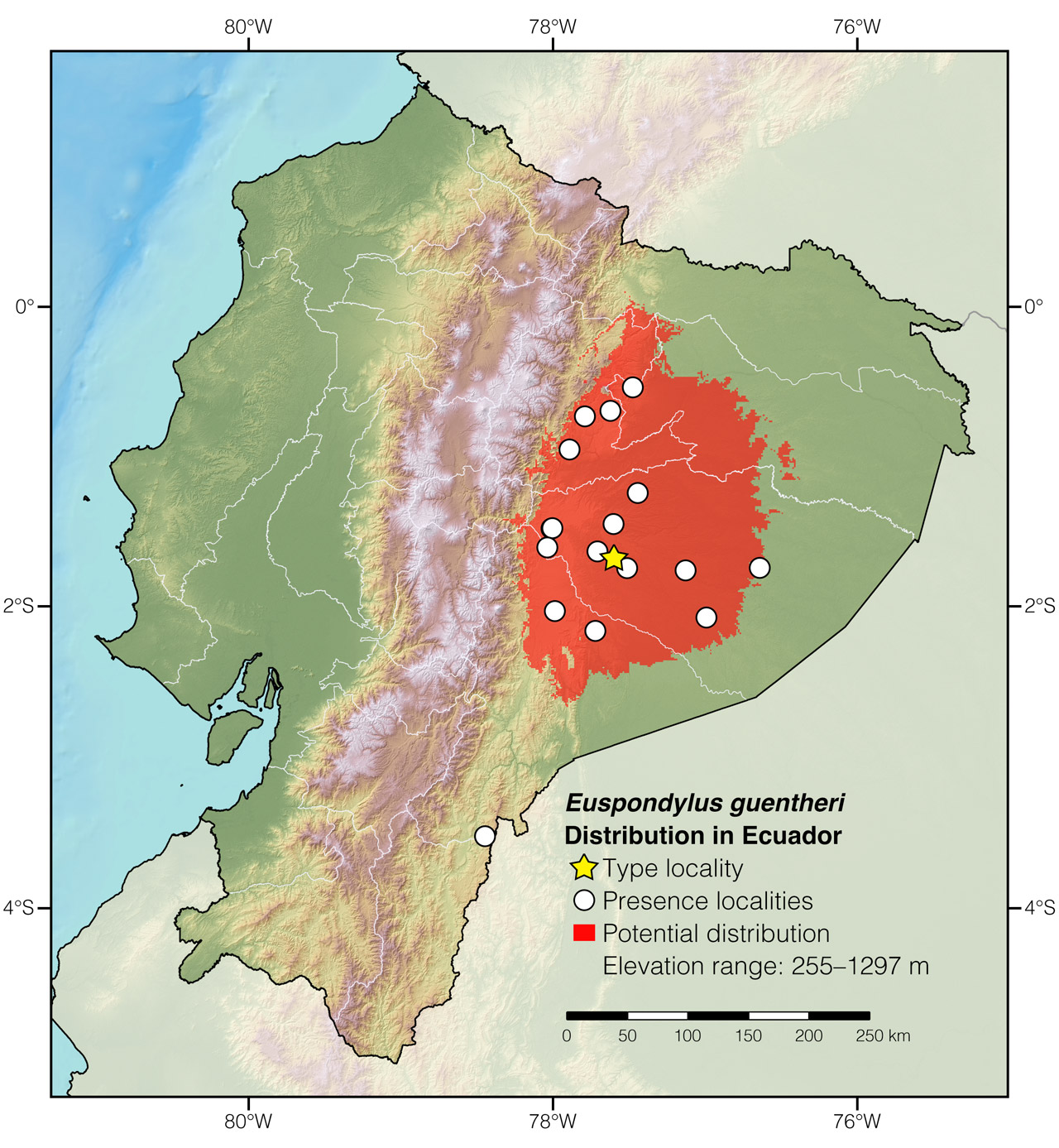
Figure 2: Distribution of Euspondylus guentheri in Ecuador. See Appendix 1 for a complete list of the presence localities included in the map.
Etymology: The generic name Euspondylus, which is derived from the Greek words eu (=easy) and spondylos (=vertebra),11 probably refers to the ease with which the caudal vertebrae in lizards of this genus can become detached to allow the shedding of the tail. The specific epithet guntheri honors Albert Günther (1830–1914), a German-born British zoologist, ichthyologist, and herpetologist, best known for his role as Keeper of Zoology at the Natural History Museum in London.
Where to observe: As one of the rarest lizards in the Amazon, only 30 sightings have ever been reported (11 museum specimens and 19 photographic records). While sightings at Río Bigal Biological Reserve have occurred more than once, they remain opportunistic. The probability of an encounter may increase by searching through thick, damp leaf-litter or turning over rocks and logs in suitable habitats.
Acknowledgments: Special thanks to Alexis Barahona, Danilo Media, Jorge Flores, José Simbaña, and Thierry García for providing locality and natural history data of Euspondylus guentheri. This account was published with the support of Secretaría Nacional de Educación Superior Ciencia y Tecnología (programa INEDITA; project: Respuestas a la crisis de biodiversidad: la descripción de especies como herramienta de conservación; No 00110378), Programa de las Naciones Unidas (PNUD), and Universidad San Francisco de Quito (USFQ).
Author: Alejandro ArteagaaAffiliation: Fundación Khamai, Reserva Arlequín, Ecoruta Paseo del Quinde km 56, Santa Rosa de Mindo, Pichincha 171202, Ecuador.
Academic reviewer: Jeffrey D CamperbAffiliation: Department of Biology, Francis Marion University, Florence, USA.
Photographer: Jose VieiracAffiliation: Tropical Herping (TH), Quito, Ecuador.,dAffiliation: ExSitu, Quito, Ecuador.
How to cite? Arteaga A (2026) Günther’s Sun Tegu (Euspondylus guentheri). In: Arteaga A, Bustamante L, Vieira J (Eds) Reptiles of Ecuador: Life in the middle of the world. Available from: www.reptilesofecuador.com. https://doi.org/10.47051/VRFJ2435
Literature cited:
- Chávez G, Catenazzi A, Venegas PJ (2017) A new species of arboreal microteiid lizard of the genus Euspondylus (Gymnophtalmidae: Cercosaurinae) from the Andean slopes of central Peru with comments on Peruvian Euspondylus. Zootaxa 4350: 301–316. https://doi.org/10.11646/zootaxa.4350.2.6
- Boulenger GA (1885) Catalogue of the lizards in the British Museum. Taylor & Francis, London, 497 pp.
- Field notes, Reptiles of Ecuador book project.
- Peters JA, Donoso-Barros R (1970) Catalogue of the Neotropical Squamata: part II, lizards and amphisbaenians. Bulletin of the United States National Museum, Washington, D.C., 293 pp.
- Danilo Medina, pers. comm.
- Jose Simbaña, pers. comm.
- Thierry García, pers. comm.
- Alexis Barahona, pers. comm.
- Lehr E, Doan TM (2016) Euspondylus guentheri. The IUCN Red List of threatened species. Available from: www.iucnredlist.org. https://doi.org/10.2305/IUCN.UK.2016-1.RLTS.T178658A50867804.en
- MAE (2012) Línea base de deforestación del Ecuador continental. Ministerio del Ambiente del Ecuador, Quito, 30 pp.
- Brown RW (1956) Composition of scientific words. Smithsonian Books, Washington D.C., 882 pp.
Appendix 1: Locality data used to create the distribution map of Euspondylus guentheri in Ecuador (Fig. 2).
| Country | Province | Locality | Source |
| Colombia | Caquetá | La Tortuga Reserve | iNaturalist; photo examined |
| Colombia | Putumayo | Reserva Fin del Mundo | Photo by Jose Vicente Rodríguez |
| Colombia | Putumayo | Reserva Natural Tunel del Dragón Verde | iNaturalist; photo examined |
| Colombia | Putumayo | Yunguillo, 5 km E of | iNaturalist; photo examined |
| Ecuador | Morona Santiago | Chiguaza | Köhler & Lehr 2004 |
| Ecuador | Morona Santiago | Macuma | UIMNH 65696; VertNet |
| Ecuador | Morona Santiago | Valle del Río Quimi | Betancourt et al. 2018 |
| Ecuador | Napo | Cascadas del Río Hollín | iNaturalist; photo examined |
| Ecuador | Napo | Challwa Yaku, 2 km N of | iNaturalist; photo examined |
| Ecuador | Napo | Colonso Chalupas Biological Reserve | Alexis Barahona, pers. comm. |
| Ecuador | Napo | Narupayacu | Photo by José Simbaña |
| Ecuador | Napo | Wild Sumaco Wildlife Sanctuary | Camper et al. (2021) |
| Ecuador | Orellana | Reserva Biológica Río Bigal | Photo by Thierry García |
| Ecuador | Pastaza | Alto Curaray | Köhler & Lehr 2004 |
| Ecuador | Pastaza | Cabeceras del Río Bobonaza | This work; Fig. 1 |
| Ecuador | Pastaza | Centro de Rescate Yanacocha | Reptiles of Ecuador book database |
| Ecuador | Pastaza | Mazaramu | Ortega-Andrade 2010 |
| Ecuador | Pastaza | Montalvo | Peters 1959 |
| Ecuador | Pastaza | Pindoyacu | Ortega-Andrade 2010 |
| Ecuador | Pastaza | Puyo | Photo by Danilo Medina |
| Ecuador | Pastaza | Río Lliquino | Köhler & Lehr 2004 |
| Ecuador | Pastaza | Santana | Köhler & Lehr 2004 |
| Ecuador | Pastaza | Sarayacu* | O’Shaughnessy 1881 |
| Ecuador | Pastaza | Tamandúa Reserve | iNaturalist; photo examined |